History of the Institution
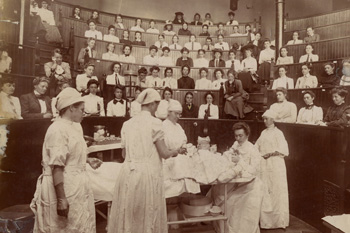
Untried and Alternative Paths in Medical Education
Drexel University College of Medicine is the successor institution of MCP Hahnemann University School of Medicine, which, prior to 1995 existed as two separate medical schools, Medical College of Pennsylvania and Hahnemann University.
Both MCP and Hahnemann arose to offer Philadelphia and the nation new opportunities in medical education. The Woman's Medical College of Pennsylvania (WMCP) grew out of the turbulent period of reformist ideas that marked the 1840s and 1850s. Among these was the "Woman Movement," announced with the Woman's Rights Convention at Seneca Falls, New York, in 1848.
In 1850, several progressive physicians and laymen in the Philadelphia region, mostly Quakers, founded the Female Medical College of Pennsylvania, the parent of WMCP. It was the first medical college in the world for women. WMCP trained thousands of women physicians who practiced in all parts of the world, many of them as medical missionaries. It also provided rare opportunities for women to teach, practice, perform research, and manage a medical school. In 1970, the school's name was changed to Medical College of Pennsylvania (MCP) following the decision to admit male medical students.
Hahnemann's parent, the Homeopathic Medical College of Pennsylvania, was founded in 1848 to teach German physician Samuel Hahnemann's new therapeutic system, homeopathy*. The system would eventually win substantial popularity in nineteenth-century America. Hahnemann Medical College flourished as the first enduring institution to teach this new system, linking it to a foundation in standard medical science and practice.
In the middle and later twentieth century, with the decline of homeopathy, Hahnemann re-invented itself as a nationally known academic medical center with prominence in cardiac surgery and cardiology, oncology, transplantation, training of non-physician health professionals, community health and community mental health.
In 1981, it became a university with four fully accredited schools: the School of Medicine, Graduate School, School of Allied Health Professions, and School of Continuing Education.
In 1995 the medical schools of the Medical College of Pennsylvania and Hahnemann University were merged under a parent organization, the Allegheny Health, Education and Research Foundation, or AHERF. In 1996, the institutions were fully merged and united as Allegheny University of the Health Sciences (AUHS). 1998 saw the decline of AHERF, which resulted in a new name for the university: MCP Hahnemann University School of Medicine (MCPHU). Drexel University operated MCPHU until it became a wholly-owned subsidiary of Drexel on July 1, 2002, now known as Drexel University College of Medicine.
Two historical studies provide substantial depth and detail on the history of the individual institutions, relying heavily on primary materials found in the archive.
- A New and Untried Course: Woman’s Medical College and Medical College of Pennsylvania 1850-1998, Steven J. Peitzman, (New Brunswick, N.J.: Rutgers University Press, 2000)
- An Alternative Path: The Making and Remaking of Hahnemann Medical College and Hospital of Philadelphia, Naomi Rogers, (New Brunswick, N.J.: Rutgers University Press, 1998)
The College of Medicine's 'About' page provides a history targeted to the University community.